
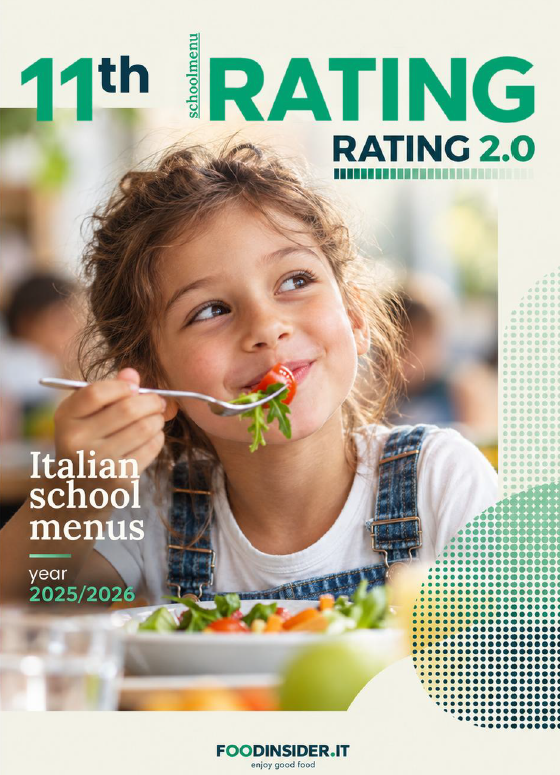
11th School Menu Rating: school meals are changing, but not enough. With Rating 2.0, a new vision of the service
Eleven years of monitoring show a school catering sector that is improving in biodiversity and the quality of raw materials, but struggles to move away from industrial products and to cut waste. The real novelty is the role of the school canteen as a food policy tool, capable of supporting health, agriculture, the environment and local economies.
The 11th Foodinsider Rating of school menus, presented on 9 November in the Press Room of the Italian Chamber of Deputies, marks the beginning of a new phase. After ten years of continuous monitoring, the Rating becomes 2.0. Created in the 2015/16 school year to observe the quality of primary school menus, the Rating has gradually evolved into a tool for analysing the evolution of Italian school catering. Today it examines 64 canteen services in 63 municipalities, which together serve about 450,000 meals a day in primary schools: a significant volume, equal to roughly 45% of the daily school meals estimated nationwide for this segment.
The new Rating 2.0 maintains continuity with the past but broadens the perspective. The quality of the service is now read through seven dimensions: biodiversity, health, processed and ultra-processed foods, gastronomic quality, local and sustainable supply chains, circular economy, and participatory governance.
More weight is given to the ability to cook, rewarding canteens that prepare vegetable-based dishes and make desserts in their own kitchens instead of relying on ready-made industrial products. Greater attention is also paid to the actual origin of raw materials, to waste reduction and to the participation of the school community. The evaluation system also introduces fixed thresholds and a scale from 0 to 100, to make the results easier to read at a glance.
Quality is improving, but change is moving at different speeds
What has changed in school canteens over these years? The data show significant progress, especially since the introduction of the Minimum Environmental Criteria (CAM, Criteri Ambientali Minimi), which have steered collective catering towards more sustainable models.
Food biodiversity is slowly gaining ground. Menus offering at least four different cereals per month rose from 40.4% in 2020 to 64.1% in 2026. Menus with no ancient grains at all are decreasing, while the variety of vegetables and side dishes is growing.
Legumes are also becoming more frequent: menus offering them as a main course at least three times a month rose from 7.7% to 31.3%. This is a positive sign, although the transition towards a more plant-based diet remains incomplete. Red meat still appears four to seven times a month in 62.5% of menus, and vegetable-based main courses appear in only 42.2% of cases.
Not all changes, however, point in the same direction. Alongside municipalities investing in variety and gastronomic quality, others are simplifying their menus, often in response to requests from families. The risk is that the search for dishes that children readily accept ends up impoverishing the food on offer, favouring plain pasta, pizza and breaded fish over more varied and nutritious preparations.
Fish is a telling case: cod and plaice dominate the menus, and in about 56% of cases they are served breaded or pre-formed, such as fish fingers, nuggets and croquettes. The presence of organic wholegrain cereals has also declined, from 33.9% in 2023 to 18.8% in 2026.
More organic and local products, but cooking must return to centre stage
The quality of raw materials is improving. 82.8% of menus offer at least 14 organic items per week, compared with 55.8% in 2020. Local supplies are also growing, and 40.6% of menus never include cured meats.
Yet, despite this progress, processed or pre-prepared products are still present in 73.4% of the menus analysed.
This is one of the contradictions that Rating 2.0 aims to highlight: buying quality raw materials is not enough if there is no capacity to turn them into fresh, balanced and appealing dishes.
Cooks must once again become protagonists of school catering, not only to improve the gastronomic value of the meal, but also to guide children in discovering new flavours, textures and foods. Quality depends not only on what is purchased, but also on how it is cooked and presented.
Less plastic, but too little is still being done about waste
On the environmental front, too, the signals are mixed. Washable tableware is now used in 82.8% of services, while the use of disposables has fallen to 12.5%. Processed desserts (puddings and fruit yoghurts) in single-serving plastic containers, offered at the end of the meal, remain a frequent presence.
Monitoring of food waste, on the other hand, remains weak, even though it is one of the key tools required by the CAM to understand how much food children actually eat and to act on the causes of waste.
26.6% of services state that they never carry out this monitoring, while the share of those doing it daily fell from 44.1% in 2023 to 20.3%.
Without measuring what is left on the plate, it is hard to know whether food choices are working, to correct recipes and to improve the service.
Meanwhile, the way meal production is organised is also changing. Large centralised kitchens remain the prevailing model, but their share has dropped to 57.8%. In-house and neighbourhood kitchens are slowly growing again, and mixed models, combining centralised production with preparation close to the schools, are becoming increasingly common.
The school canteen becomes a lever for food policy
The most interesting change described by the 11th Rating concerns not only what children eat, but what the canteen can generate in the local area.
In several places, school catering is becoming the starting point for genuine food policies: policies capable of linking public demand to agricultural production, environmental sustainability, job quality and community development.
The report identifies two reference models.
The first is that of vertical food policies, developed mainly in larger cities, where administrations use tender specifications and procurement to steer the urban food system. These experiences can move large volumes of meals and influence supply chains, but are often built around the specific characteristics of the city.
The second is that of horizontal food policies, such as the Laore experience in Sardinia, which connect several municipalities, farmers and catering operators, building shared tools, skills and relationships. These involve smaller volumes, but have very significant potential for replication.
In both cases a new perspective emerges: spending on school meals is not simply a cost to be contained, but can become an investment that produces economic, social and environmental benefits.
From menu quality to food system change
After eleven years of observation, the Foodinsider Rating therefore presents a picture of progress, resistance and opportunities still to be seized.
The CAM have helped to steer change, but their application is not uniform. Rules alone are not enough. The difference is made by the administrations and operators who manage to turn them into concrete practice: planning purchases, choosing supply chains, valuing the skills of cooks, monitoring waste, involving families and investing in the quality of the service.
The message of the 11th Rating is above all an invitation to change how we look at the school canteen.
The canteen is a tool of social policy, because it can guarantee every child a quality meal, regardless of the family’s economic circumstances. It is a tool of environmental policy, because it can reduce waste and refuse, promote biodiversity and support more resilient agricultural production. And it is a tool of economic policy, because through public procurement it can generate stable demand for farmers, cooperatives and local businesses.
The roughly 450,000 meals served every day by the services analysed represent an economic force which, if guided by a long-term vision, can make a concrete contribution to transforming local food systems.
Investing in school canteens therefore means investing at the same time in children, health, agriculture, jobs and the quality of public policy.
This is the challenge Foodinsider entrusts to Rating 2.0: moving from the evaluation of menus to an awareness of the canteen’s potential as an engine of change.
The REPORT of the 11th Rating is available for download.